
Yeah, it was a pretty terrible movie. Glad I didn’t pay money to see it.

Yeah, it was a pretty terrible movie. Glad I didn’t pay money to see it.

I’ve been wondering about this for awhile now. Seriously, the whole point of the song is the dude wants the lady he’s singing to not to say she loves him, but to get down and get busy to show him she loves him. It’s…really skeevy, if you ask me. Which of course you do, because why else would you be here?
George Harrison was always known as “the quiet Beatle.” You had John, the outspoken, brash, social commentating wise-guy; Paul was the cute one, the one with the cherub cheeks and the delicious understanding of pop melodies; Ringo was the drummer, a nice guy, the one with the big nose; George was the quiet one. He was the weird one, the one who dabbled in Eastern music and Eastern philosophy. A hell of a guitar player. John and Paul would occasionally toss him a bone and let him have a song or two per album, but that was about it.
You could see towards the end of the Beatles’ career that George was starting to come into himself as a songwriter. His two contributions to Abbey Road, “Something” and “Here Comes the Sun,” are among the most-loved and best songs of the entire Beatles catalog. There were hints that George had more, much more, to say, and only needed the space and the opportunity to say it.
Well, he got the chance on All Things Must Pass, a triple-album chock-full of all the pent-up frustration George felt in those closing years with the Beatles. And damn if it didn’t make for some of the absolute best music ever.
The CD reissue of George’s opus retains all the original stuff from those three records, plus it throws in a handful of demo cuts and a new recording of one of the album’s key tracks, “My Sweet Lord.” And thanks to CD technology, you get it all on a very managable two CDs rather than three cumbersome vinyl records (though there is something to be said for the old records…I mean, c’mon, this stuff is what vinyl was made for).
To be blunt, there’s really not a bad cut on this set. The jams that made up the third record (the last about four or five tracks on disc 2 of the CD collection) are a little unnecessary, but you do get a sneak peak at the creation of one of the best groups ever, Derek and the Dominoes (the future members of that band all appear on this record, and all are involved in the jams. You kinda get a feeling for the direction Derek and the Dominoes would later take, which is neat). But the rest of the album is top-notch, proving that George could be every bit as inspired and prolific as Lennon and McCartney.
First, the music–George utilized Phil Spector’s “Wall of Sound” technique in recording this album, which means everything sounds big and full and lush. George brought in more musicians than you can shake a stick at (most of whom went uncredited, though some–like Eric Clapton–went uncredited due to record label issues). There are several tracks where you have a half dozen different guitars being played all at once, and each one is strumming a slightly different pattern, and it all just fits together. This record sounds big, sounds like it’s making a statement, and that’s exactly what it does.
Every song on here is good, which is impressive not only for an album of this size and scope, but for a solo project (though the inclusion of two different versions of “Isn’t it a Pity” seems a little unnecessary. Admittedly, it’s a great song with a beautiful melody, and the two different versions have enough variation that you don’t mind hearing it twice, so it’s okay). Most of these are originals (with the exception of a smooth cover of Bob Dylan’s “If Not for You,” a song which George helped Dylan come up with anyway, and the opener, “I’d Have You Anytime,” co-written by Dylan and Harrison), and Harrison makes some remarkable statements about himself, his history, the world in general, and life and death. These are heavy themes, but Harrison treats them with a stately dignity, and the songs never feel heavy handed or preachy (problems which some later Harrison songs would suffer from).
Lyrically, Harrison is in fine form here. “My Sweet Lord” is a beautiful meditation on the singer’s desire to know the nature of God; “Apple Scruffs” is an endearing tribute to a group of dedicated Beatles fans; “What is Life” is a rolicking, chugging love song with a punchy horn section; “Isn’t it a Pity” is a beautiful plea for peace, love, and understanding; and the title track is one of the deepest, most meaningful songs ever written.
That song, “All Things Must Pass,” is laden with meaning. On one level, it’s about the demise of the Beatles. On another, it’s about the end of a relationship. On yet another, it’s about life, death, and the transitory nature of reality. But Harrison never treats this passing as a negative thing. All things, he says, must pass; that is the nature of life. “Sunrise doesn’t last all morning,” he sings, but just as the good will pass, so will the bad: “Darkness only stays the nighttime,” and “It’s not always going to be this grey.” This is the ultimate song of hope: Harrison knows that nothing is here to stay, and that gives him a strange sense of comfort, because it means the chaos doesn’t last forever, either. It’s a beautiful, bittersweet notion that Harrison conveys in one of his most achingly beautiful melodies, a slow, strummed acoustic guitar setting the pace, and layers of guitar (slide and acoustic) and a subdued horn section only drive the point home.
One of the key features of the album is Harrison’s fascination with Eastern philosophy and religion. Several of the songs have religious elements or themes, whether it’s the prayer of “My Sweet Lord,” coming to terms with “The Art of Dying,” or “Chanting the Name of the Lord,” who is awaiting on us all (in “The Lord is Awaiting on You All,” of course). Harrison is nigh obsessed with the notion of God, deity, and the divine, and his own particular spirituality permeates every aspect of this album.
The CD reissue adds four new tracks–demo versions of “Beware of Darkness” and “Let it Down,” an alternate instrumental version of “What is Life,” and a new version of “My Sweet Lord” dubbed “My Sweet Lord (2000).” The two demos are excellent. “Beware of Darkness” almost has more impact in the simple acoustic guitar setting of the demo than in the final version, and “Let it Down” is more harrowing without the horns and backup singers. The instrumental of “What is Life” is interesting for the variation on the horn part from the original, and it makes for a fun karaoke verison to sing along to in the shower. The new “My Sweet Lord” featuers some breathtaking slide guitar work from George and a slightly varied arrangement and instrumentation, but the effect is rather ruined by the backup singer and Harrison’s own rather ragged vocal performance.
All Things Must Pass is one of the best rock albums of all time, hands down. None of the other former Beatles released anything like it upon the band’s initial breakup. It rivals McCartney’s Band on the Run and Lennon’s Imagine as the best ex-Beatle solo album, and for good reason. George may have been the quiet Beatle, but that was only because he was saving up all his words for this record.
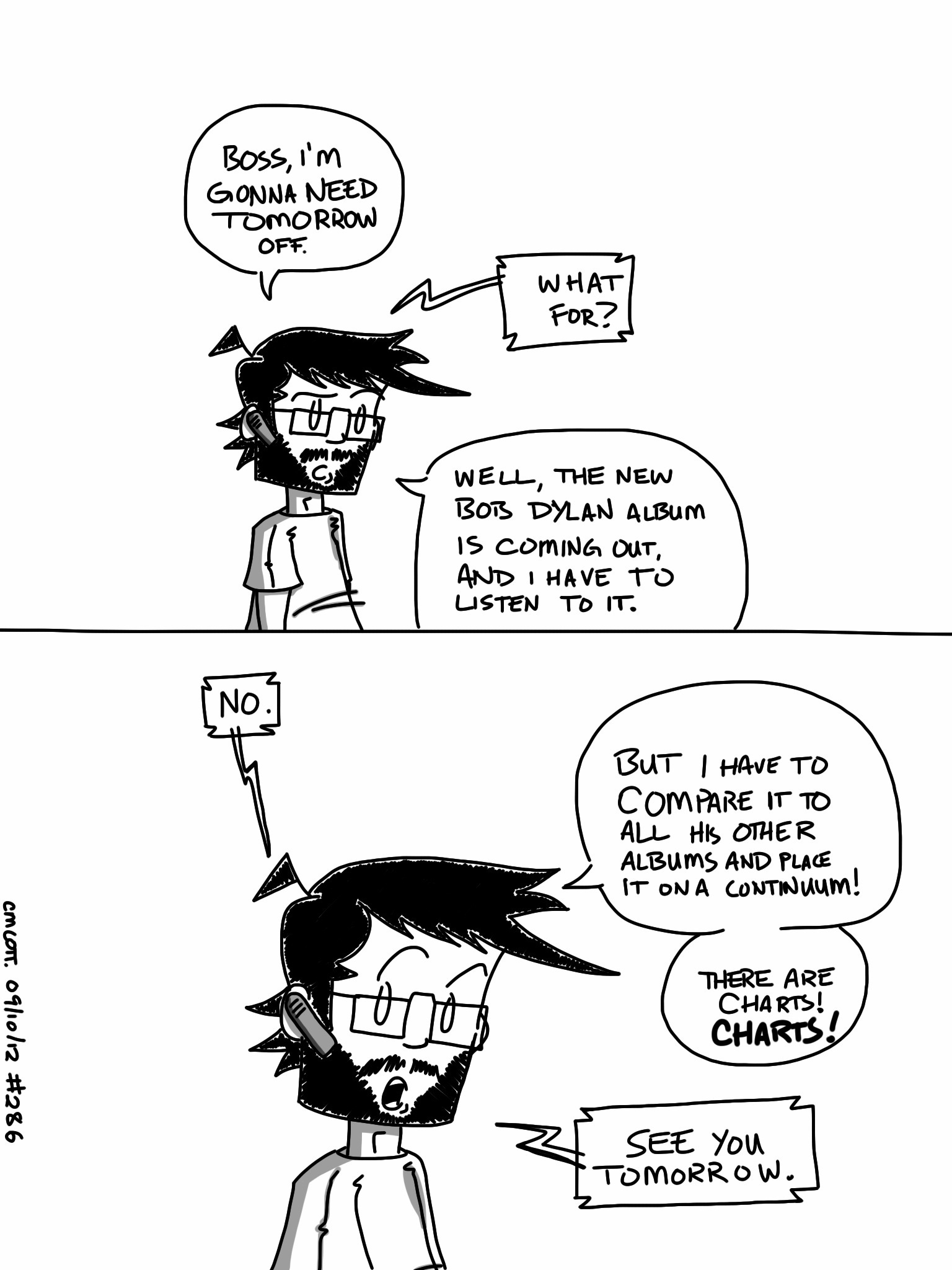
I am very excited about the new Dylan album, Tempest, that’s out tomorrow. A year with new Dylan is a good year indeed.
Another album review from the vaults as I continue to cannibalize my younger self’s work for present-day self’s own enjoyment and sense of fulfillment.
Astral Weeks is an album unlike anything else in Van Morrison’s catalogue. The fact that this can be said about virtually every single album he’s made doesn’t discount the uniqueness of this record, nor does it mean there is no cohesion or a sense of connected style across his body of work. It simply means that Van is flexible enough to be able to ingest a huge number of styles, synthesize them, and make them his own.
Astral Weeks is Van’s first true solo album, and it marks a radical departure from his work with the R&B combo Them. The making of the album is an amazing story–originally, Van signed to Bang Records after he left Them in 1968, and recorded songs such as “TB Sheets” and “Brown-Eyed Girl” for the label. However, they wanted him to replicate “Brown-Eyed Girl” with other singles, and Morrison wanted to follow a very different muse. He was under contract to record a set number of songs for Bang, so he went about recording a couple dozen song tidbits that are so completely throwaway that even completists and total fanatics dismiss them as irrelevant. His contractual obligations thus fulfilled, Van struck out on his own, eventually landing with Warner Brothers.
The album he recorded for Warner Bros. came from left field. He had the engineer for the record hire a group of session players, none of whom had ever even met each other, let alone Van. They recorded the album in the space of a few nights, coming together in the studio at the tail end of the night after they’d been playing with other bands and musicians all evening. This adds to the tone of late night, pre-dawn dreaminess that pervades the record. Musically, the instrumentation–which is very sparse, consisting mostly of acoustic guitar, acoustic bass, light drums (usually just the cymbals and high-hat), a few dashes of strings, a flute every now and then, and Van’s vocals–melds together well, especially for musicians who had never really worked together and didn’t really know the songs beforehand. The music threatens to float off into the ether at any moment, and words like “effervescent” and “ephemeral” are good descriptors. Most of the songs consist of rather repetitive chord progressions with little variation within a single song, giving the songs a pulse that lulls you.
Thematically, Van attempts to create a new mythology of his hometown of Belfast. The songs not only address the town, but Van’s attempts to come to grips with where he came from and where he is going, which is far away from home. However, he can never truly escape Belfast, as he is always “caught one more time” there, unable to truly let go of the past, but wanting desperately to break through to someplace better.
The album boasts some exceptional songs, lyrically. “Sweet Thing” is a beautiful paean to a lover, “Cyprus Avenue” paints a portrait of Van’s Belfast in such striking terms and colors that you feel you are walking down the street with him, and “Madam George” is a character sketch that only really hints at the true identity of the titular character.
Overall, Van Morrison’s Astral Weeks is a beautiful, moving album, one which speaks quietly rather than screaming from the speakers. There are layers of sound and meaning hidden within the record, and for those willing to dig into it, the rewards are great.

Did you know those things are all different? It’s not just the same stuff in four different bottles, apparently.
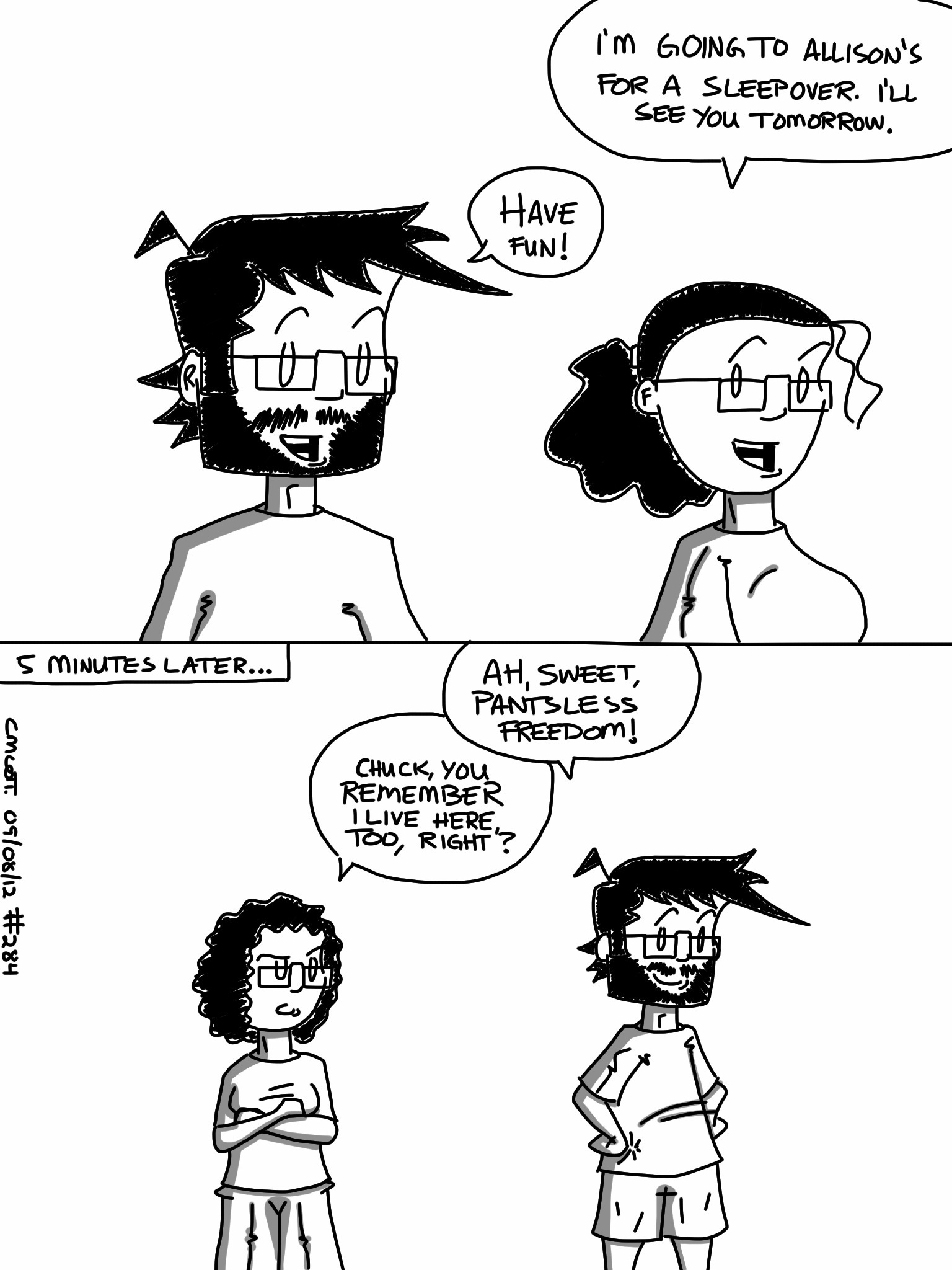
The wife is over at her sister’s place tonight, so I’ve got the place to myself!
Well, except for the other sister-in-law, who happens to live with us.
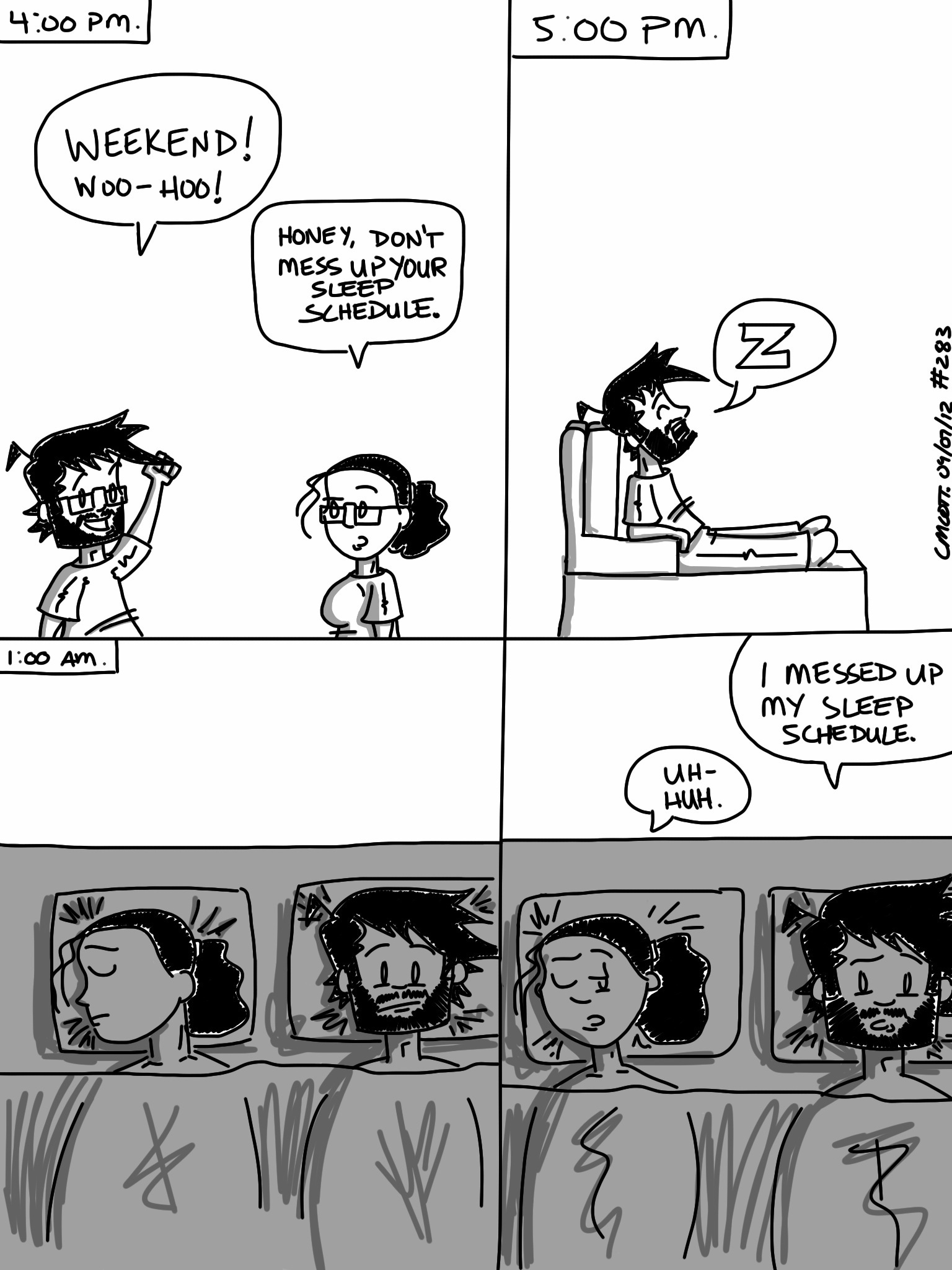
I didn’t nap this evening, but this is a fairly common occurrence around here.
Here’s yet another album review, this one from September 2004. Apparently I spent all of graduate school listening to music and telling anyone who would listen what I thought about it.
So my most recent musical acquisition has been the Old 97’s fourth album, Fight Songs. It’s the follow-up to Too Far To Care, which is still their best record in my opinion.
The most noticeable difference between the two albums is the musical tone. Whereas Too Far To Care approached country music from a punk angle, Fight Songs takes the more traditional country-rock approach, a la Neil Young or some of Dylan’s ’70’s work. There’s still plenty of energy and twang here, but a lot of the ragged edges have been smoothed in favor of songcraft and melody.
The tradeoff works well, in this case. Rhett Miller’s lyrics and croon take centerstage, and his wordplay is as sharp as ever. Miller spent much of Too Far To Care yelping and speeding through his lyrics, attempting to keep up with the hyperactive music. On Fight Songs, he’s slowed down, giving each phrase the time and attention it deserves. He’s also toned down the vocal theatrics. Miller sings most of the songs with a croon reminiscient of Jeff Tweedy’s (from Wilco) or Elliot Smith, though more melodic than the former and less fragile than the latter.
Despite this slight stylistic shift in music and vocals, there are still plenty of rockers on the album. The lead-off tune, “Jagged,” keeps a great beat and has wicked lyrics. “Oppenheimer” sounds like something off of Rhett Miller’s solo album The Instigator in terms of the music and his delivery. “Indefinitely” has some wonderful vocal interplay between Miller and bassist Murray Hammond, and is one of the most straight-ahead pop-rock tunes on the album.
The highlight of the disc, though, is the closer “Valentine,” which features just an acoustic guitar, acoustic bass, and vocals courtesy of Murray Hammond (backed up by Miller). Lyrically, the song could be an old Willie Nelson or Merle Haggard tune, and features lines such as “Valentine the destroyer” and “Of all the many ways a man will break his heart/well there ain’t none meaner than he pulls his own apart.” It’s a witty, nakedly honest tune that leaves you wondering whether you’re supposed to smile or frown, and it closes out the album perfectly.
All in all, Fight Songs is a worthwhile effort from the Old 97’s. While it lacks Too Far To Care’s manic energy and enthusiasm, it’s still a fine album filled with wonderful tunes. Besides, Too Far To Care‘s shoes are pretty big to fill, and rather than attempting to, the Old 97’s took their music in a slightly different, and ultimately just as satisfying, direction.

