George Harrison – All Things Must Pass

George Harrison was always known as “the quiet Beatle.” You had John, the outspoken, brash, social commentating wise-guy; Paul was the cute one, the one with the cherub cheeks and the delicious understanding of pop melodies; Ringo was the drummer, a nice guy, the one with the big nose; George was the quiet one. He was the weird one, the one who dabbled in Eastern music and Eastern philosophy. A hell of a guitar player. John and Paul would occasionally toss him a bone and let him have a song or two per album, but that was about it.

You could see towards the end of the Beatles’ career that George was starting to come into himself as a songwriter. His two contributions to Abbey Road, “Something” and “Here Comes the Sun,” are among the most-loved and best songs of the entire Beatles catalog. There were hints that George had more, much more, to say, and only needed the space and the opportunity to say it.

Well, he got the chance on All Things Must Pass, a triple-album chock-full of all the pent-up frustration George felt in those closing years with the Beatles. And damn if it didn’t make for some of the absolute best music ever.

The CD reissue of George’s opus retains all the original stuff from those three records, plus it throws in a handful of demo cuts and a new recording of one of the album’s key tracks, “My Sweet Lord.” And thanks to CD technology, you get it all on a very managable two CDs rather than three cumbersome vinyl records (though there is something to be said for the old records…I mean, c’mon, this stuff is what vinyl was made for).

To be blunt, there’s really not a bad cut on this set. The jams that made up the third record (the last about four or five tracks on disc 2 of the CD collection) are a little unnecessary, but you do get a sneak peak at the creation of one of the best groups ever, Derek and the Dominoes (the future members of that band all appear on this record, and all are involved in the jams. You kinda get a feeling for the direction Derek and the Dominoes would later take, which is neat). But the rest of the album is top-notch, proving that George could be every bit as inspired and prolific as Lennon and McCartney.

First, the music–George utilized Phil Spector’s “Wall of Sound” technique in recording this album, which means everything sounds big and full and lush. George brought in more musicians than you can shake a stick at (most of whom went uncredited, though some–like Eric Clapton–went uncredited due to record label issues). There are several tracks where you have a half dozen different guitars being played all at once, and each one is strumming a slightly different pattern, and it all just fits together. This record sounds big, sounds like it’s making a statement, and that’s exactly what it does.

Every song on here is good, which is impressive not only for an album of this size and scope, but for a solo project (though the inclusion of two different versions of “Isn’t it a Pity” seems a little unnecessary. Admittedly, it’s a great song with a beautiful melody, and the two different versions have enough variation that you don’t mind hearing it twice, so it’s okay). Most of these are originals (with the exception of a smooth cover of Bob Dylan’s “If Not for You,” a song which George helped Dylan come up with anyway, and the opener, “I’d Have You Anytime,” co-written by Dylan and Harrison), and Harrison makes some remarkable statements about himself, his history, the world in general, and life and death. These are heavy themes, but Harrison treats them with a stately dignity, and the songs never feel heavy handed or preachy (problems which some later Harrison songs would suffer from).

Lyrically, Harrison is in fine form here. “My Sweet Lord” is a beautiful meditation on the singer’s desire to know the nature of God; “Apple Scruffs” is an endearing tribute to a group of dedicated Beatles fans; “What is Life” is a rolicking, chugging love song with a punchy horn section; “Isn’t it a Pity” is a beautiful plea for peace, love, and understanding; and the title track is one of the deepest, most meaningful songs ever written.

That song, “All Things Must Pass,” is laden with meaning. On one level, it’s about the demise of the Beatles. On another, it’s about the end of a relationship. On yet another, it’s about life, death, and the transitory nature of reality. But Harrison never treats this passing as a negative thing. All things, he says, must pass; that is the nature of life. “Sunrise doesn’t last all morning,” he sings, but just as the good will pass, so will the bad: “Darkness only stays the nighttime,” and “It’s not always going to be this grey.” This is the ultimate song of hope: Harrison knows that nothing is here to stay, and that gives him a strange sense of comfort, because it means the chaos doesn’t last forever, either. It’s a beautiful, bittersweet notion that Harrison conveys in one of his most achingly beautiful melodies, a slow, strummed acoustic guitar setting the pace, and layers of guitar (slide and acoustic) and a subdued horn section only drive the point home.

One of the key features of the album is Harrison’s fascination with Eastern philosophy and religion. Several of the songs have religious elements or themes, whether it’s the prayer of “My Sweet Lord,” coming to terms with “The Art of Dying,” or “Chanting the Name of the Lord,” who is awaiting on us all (in “The Lord is Awaiting on You All,” of course). Harrison is nigh obsessed with the notion of God, deity, and the divine, and his own particular spirituality permeates every aspect of this album.

The CD reissue adds four new tracks–demo versions of “Beware of Darkness” and “Let it Down,” an alternate instrumental version of “What is Life,” and a new version of “My Sweet Lord” dubbed “My Sweet Lord (2000).” The two demos are excellent. “Beware of Darkness” almost has more impact in the simple acoustic guitar setting of the demo than in the final version, and “Let it Down” is more harrowing without the horns and backup singers. The instrumental of “What is Life” is interesting for the variation on the horn part from the original, and it makes for a fun karaoke verison to sing along to in the shower. The new “My Sweet Lord” featuers some breathtaking slide guitar work from George and a slightly varied arrangement and instrumentation, but the effect is rather ruined by the backup singer and Harrison’s own rather ragged vocal performance.

All Things Must Pass is one of the best rock albums of all time, hands down. None of the other former Beatles released anything like it upon the band’s initial breakup. It rivals McCartney’s Band on the Run and Lennon’s Imagine as the best ex-Beatle solo album, and for good reason. George may have been the quiet Beatle, but that was only because he was saving up all his words for this record.
Van Morrison – Astral Weeks

Another album review from the vaults as I continue to cannibalize my younger self’s work for present-day self’s own enjoyment and sense of fulfillment.

Astral Weeks is an album unlike anything else in Van Morrison’s catalogue. The fact that this can be said about virtually every single album he’s made doesn’t discount the uniqueness of this record, nor does it mean there is no cohesion or a sense of connected style across his body of work. It simply means that Van is flexible enough to be able to ingest a huge number of styles, synthesize them, and make them his own.

Astral Weeks is Van’s first true solo album, and it marks a radical departure from his work with the R&B combo Them. The making of the album is an amazing story–originally, Van signed to Bang Records after he left Them in 1968, and recorded songs such as “TB Sheets” and “Brown-Eyed Girl” for the label. However, they wanted him to replicate “Brown-Eyed Girl” with other singles, and Morrison wanted to follow a very different muse. He was under contract to record a set number of songs for Bang, so he went about recording a couple dozen song tidbits that are so completely throwaway that even completists and total fanatics dismiss them as irrelevant. His contractual obligations thus fulfilled, Van struck out on his own, eventually landing with Warner Brothers.

The album he recorded for Warner Bros. came from left field. He had the engineer for the record hire a group of session players, none of whom had ever even met each other, let alone Van. They recorded the album in the space of a few nights, coming together in the studio at the tail end of the night after they’d been playing with other bands and musicians all evening. This adds to the tone of late night, pre-dawn dreaminess that pervades the record. Musically, the instrumentation–which is very sparse, consisting mostly of acoustic guitar, acoustic bass, light drums (usually just the cymbals and high-hat), a few dashes of strings, a flute every now and then, and Van’s vocals–melds together well, especially for musicians who had never really worked together and didn’t really know the songs beforehand. The music threatens to float off into the ether at any moment, and words like “effervescent” and “ephemeral” are good descriptors. Most of the songs consist of rather repetitive chord progressions with little variation within a single song, giving the songs a pulse that lulls you.

Thematically, Van attempts to create a new mythology of his hometown of Belfast. The songs not only address the town, but Van’s attempts to come to grips with where he came from and where he is going, which is far away from home. However, he can never truly escape Belfast, as he is always “caught one more time” there, unable to truly let go of the past, but wanting desperately to break through to someplace better.

The album boasts some exceptional songs, lyrically. “Sweet Thing” is a beautiful paean to a lover, “Cyprus Avenue” paints a portrait of Van’s Belfast in such striking terms and colors that you feel you are walking down the street with him, and “Madam George” is a character sketch that only really hints at the true identity of the titular character.

Overall, Van Morrison’s Astral Weeks is a beautiful, moving album, one which speaks quietly rather than screaming from the speakers. There are layers of sound and meaning hidden within the record, and for those willing to dig into it, the rewards are great.

Old 97’s – Fight Songs

Here’s yet another album review, this one from September 2004. Apparently I spent all of graduate school listening to music and telling anyone who would listen what I thought about it.

So my most recent musical acquisition has been the Old 97’s fourth album, Fight Songs. It’s the follow-up to Too Far To Care, which is still their best record in my opinion.

The most noticeable difference between the two albums is the musical tone. Whereas Too Far To Care approached country music from a punk angle, Fight Songs takes the more traditional country-rock approach, a la Neil Young or some of Dylan’s ’70’s work. There’s still plenty of energy and twang here, but a lot of the ragged edges have been smoothed in favor of songcraft and melody.

The tradeoff works well, in this case. Rhett Miller’s lyrics and croon take centerstage, and his wordplay is as sharp as ever. Miller spent much of Too Far To Care yelping and speeding through his lyrics, attempting to keep up with the hyperactive music. On Fight Songs, he’s slowed down, giving each phrase the time and attention it deserves. He’s also toned down the vocal theatrics. Miller sings most of the songs with a croon reminiscient of Jeff Tweedy’s (from Wilco) or Elliot Smith, though more melodic than the former and less fragile than the latter.

Despite this slight stylistic shift in music and vocals, there are still plenty of rockers on the album. The lead-off tune, “Jagged,” keeps a great beat and has wicked lyrics. “Oppenheimer” sounds like something off of Rhett Miller’s solo album The Instigator in terms of the music and his delivery. “Indefinitely” has some wonderful vocal interplay between Miller and bassist Murray Hammond, and is one of the most straight-ahead pop-rock tunes on the album.

The highlight of the disc, though, is the closer “Valentine,” which features just an acoustic guitar, acoustic bass, and vocals courtesy of Murray Hammond (backed up by Miller). Lyrically, the song could be an old Willie Nelson or Merle Haggard tune, and features lines such as “Valentine the destroyer” and “Of all the many ways a man will break his heart/well there ain’t none meaner than he pulls his own apart.” It’s a witty, nakedly honest tune that leaves you wondering whether you’re supposed to smile or frown, and it closes out the album perfectly.

All in all, Fight Songs is a worthwhile effort from the Old 97’s. While it lacks Too Far To Care’s manic energy and enthusiasm, it’s still a fine album filled with wonderful tunes. Besides, Too Far To Care‘s shoes are pretty big to fill, and rather than attempting to, the Old 97’s took their music in a slightly different, and ultimately just as satisfying, direction.

Billy Bragg and Wilco, Mermaid Avenue, Volume 1

I continue scavenging my own body of work for fun things to repost here. Have another album review, written sometime back in 2003, I believe, when I was but a poor graduate student.

It seems like a bad idea on the face of it–take a bunch of unused Woody Guthrie song lyrics and let a couple of contemporary musicians set them to music and record them. God only knows what sort of crap you’ll get–either stuff that tries too hard to be Guthrie and fails, or stuff that completely ignores Guthrie and fails.

But what we ended up with isn’t either of those. No, what we got is absolutely wonderful, 15 songs of absolute majesty, humor, warmth, wit, anger, and acute insight into not only the mind of one of American music’s most important songwriters, but a glimpse of the America he lived in and how that America was the same as and different from the America of his dreams. What we got is Mermaid Avenue.

The songs on this album (and its second volume, released a couple of years later) all used lyrics Woody Guthrie wrote from the late 1940s until his death in 1967. Guthrie himself stopped performing after about 1950 due to a neurological disease, but he kept writing until he died. In the early 1960s, he offered the lyrics to a young Bob Dylan, who initially took him up on the offer but was never able to get them from Guthrie’s wife (Dylan made mention of this in his excellent memoir Chronicles, Volume 1). Instead, almost forty years down the road, Guthrie’s daughter offered the lyrics to Billy Bragg, who promptly called up alt-country heroes Wilco and got down to picking out fifteen absolute gems for this record.

The album opens with the drunken sea shanty “Walt Whitman’s Niece,” a sly and raucous song about two drunken sailors in search of comfort and whores (there’s really no more polite way to phrase it, honest). It just gets better from there. Guthrie had a knack for capturing very human portraits in his music and for crafting wonderful images in his short, economical lyrical style.

The songs are divyed up between Bragg and Wilco, each taking a turn fronting the song (which means you’ve got either Bragg or Jeff Tweedy singing, essentially, though there’s one tune where Natalie Merchant takes the lead vocal to great effect). Each partner in this endeavour came up with music for a particular set of lyrics–Bragg was responsible for songs like “Walt Whitman’s Niece” and “Way Over Yonder in a Minor Key,” while Wilco did duty on “California Stars” and “Christ for President.” Each partner brought a different style and aesthetic to their songs, but the overall effect is very pleasing and very consistent. Bragg’s numbers tend to be more universal and enjoyable, though Wilco turns the children’s song “Hoodoo Voodoo” into a bright, cheerful sing-along. Wilco’s contributions, while not slouchy in any way, just aren’t as timeless as Bragg’s, and seem very much a part of the moment they were written in (you can hear that Wilco is between their Being There and SummerTeeth albums).

This is an album of wonderful gems of songs. “Way Over Yonder in a Minor Key” is a funny, dirty song about a young man in Okfuskee County (home of Okemah, Oklahoma, Guthrie’s home town) who convinces a young lady to go off with him into the woods to a “holler tree” (that’s “hollow tree” for those of you who don’t speak Okie) and take off her shirt by telling her that, yes, he may be ugly, but “there ain’t nobody who can sing like me.” “Christ for President” is a reminder that, while Guthrie was a Christian and a man of fairly traditional values, he was also a leftist who thought that big business and the government were ruining the country and perhaps America would be better if it followed true Christian values, starting with tossing the ol’ moneychangers out of the Temple.

Mermaid Avenue is a rousing, eclectic collection of excellent songs. It’s a reminder of Guthrie’s breadth and depth as a writer, and a fitting tribute to one of the icons of American music. But this is no mere tribute album; rather, it’s a true collaboration–lyrics from Guthrie, and music that makes no attempt to mimic or imitate Guthrie’s musical style from Bragg and Wilco. But even without attempting to sound like Guthrie in their playing, the partners manage to invoke Guthrie’s spirit and power in their music. It sounds nothing like the sort of songs Guthrie himself wrote, but you can feel his energy pulsing through these songs nonetheless. And that’s the greatest thing about the record–Bragg and Wilco’s contributions don’t feel grafted on, nor do Guthrie’s lyrics feel like they were crammed into existing melodies in some shoddy, half-assed effort to make money off a dead man. No, this is real collaboration across forty years’ time, and it works. I can’t wait to go pick up Volume 2 next paycheck.

Bob Dylan – Oh Mercy

This is actually a repost from an old blog of mine, but I thought it’d be fun to put it up here as well. Enjoy!

I’m always apprehensive about picking up anything Dylan did in the ’80s. The decade wasn’t too kind to him (his three evangelist Christian albums at the beginning of the decade are so abyssmal in certain ways that next to no one will listen to them), and the albums he made that were worthwhile still contained a seed of doubt and a bit of distrust. Most of his ’80s work was simply too smooth, too glossy, too glitzy. In short, not Dylan. Dylan’s music, while well-crafted, has always had a rough-and-tumble quality to it that disappeared for a lot of his ’80s work. Combine it with a dearth of decent songs, awkward and preachy (literally) lyrics that simply aped dogma, and a public that was turning to new wave and punk, and Dylan really seemed out of place in the 1980s.

Oh Mercy was something of a comeback for Dylan, and certainly the most interesting solo work he’d done since 1983’s Infidels. The production, provided by Daniel Lanois (who would also helm Dylan’s late ’90s Grammy-winning record Time Out of Mind, a record which owes much to Oh Mercy sonically speaking), creates a rather foreboding, haunting atmosphere, a perfect match to the lyrics and melodies Dylan wrote.

Musically, this album works better than anything Dylan had recorded since the late ’70s. Haunting ballads, piano-driven contemplations, and tight rockers fill this record, and the instruments sound like they’ve been played in an echo chamber. The murky, atmospheric production works in the songs’ favor, giving them an otherworldly feel.

Lyrically, Dylan is back in fine form. “Political World” kicks off the album with a litany of the problems with the modern world, while “Everything is Broken” delves even deeper into the bruised and wounded psyche of contemporary society. “Ring Them Bells” is one of Dylan’s most thoughtful contemplations on the nature of the soul, mankind, and the place where the two meet, and its subtle instrumentation and vocal delivery work perfectly. “Most of the Time,” “What Good am I?” and “Shooting Star” are some of Dylan’s most searching ballads, exploring ideas of loss, regret, purpose, and what might have been (or ought to be). In fact, “Most of the Time” is one of the best songs Dylan has written, whether in the ’80s or in his peak days of the ’60s or ’70s. There’s a stately grace and maturity to the song which is offset by the adolescent idea of being okay with the break up “most of the time.” The lyrics belie that assertion–the narrator is trying too hard to convince someone, either the object of his affection or himself, that he’s okay with not being with her anymore, and only serves to prove that he is not over her. The song also features one of the best (and few) bridges Dylan ever wrote, and the song scales to new heights to meet it, then gears back down into its melancholic groove to finish the song off.

Oh Mercy was an album that proved Dylan still had his skills and his wits about him. Musically and lyrically, it recalled Dylan at his best–not because he simply aped the styles and themes which made him famous, but because he tapped into the same creative force which drove those early masterpieces. He recalled his best work by making a record of equal caliber, something which most musicians entering in their third or fourth decade of music would have a difficult time duplicating. Oh Mercy is a minor masterpiece, a latter-day Dylan album that fans of the young visionary Dylan can admire and enjoy.

Delayed Reaction: Sucking on Counting Crows’ Hard Candy

As with most bands that were popular in the ’90s, I came to the Counting Crows rather late in the game (like, around 2002 or so). While August and Everything After and Recovering the Satellites are obvious and pretty much indisputable classics at this point, I’m not sure the same holds true for the albums that came after. This Desert Life feels like the band decided to abandon any semblance of rock and roll for a slightly folky, Rod Stewart-meets-Van Morrison-doing-adult-contemporary sorta vibe (though I still love “Mrs. Potter’s Lullaby” from that record, I don’t care what you think). And then there’s Hard Candy.

Now, I’ll admit that when this album first came out, I listened to it on repeat for about three months, basically. But in the past six or seven years, it hasn’t come up on the iPod much. I decided to give it a spin yesterday, to see if it held up after all this time.

The good news is, the good songs on the record are still very, very good. Unfortunately, I’ve developed less of a tolerance for Adam Duritz’s vocal affectations, and several of the songs are just a slow, mellow mess of blah. Let’s dig in, shall we?

Things start off right with the neo-Byrdsian title track, with its ringing electric twelve string intro and its singalong chorus, remains my favorite song on the record. From there, the album goes to 2002 Top-40 Radio staple “American Girls,” a song which I admit strikes me as just really annoying ten years on. From there, things move into slow jam territory with “Good Time,” a song I just went ahead and skipped over (I didn’t care for it back in 2002, either). From there, the album alternates between upbeat, slightly off-kilter songs that I really enjoy like “If I Could Give All My Love to You (Richard Manuel Is Dead),” “New Frontier,” and “Up All Night (Frankie Miller Goes to Hollywood)”, slower songs that aren’t too bad like “Why Should You Come When I Call” and “Holiday in Spain,” and songs that I just find boring, which is essentially everything else.

Other tracks on the album include the snooze-fests that are “Carriage,” “Miami,” and “Black and Blue” and the downright unlistenable “Butterfly in Reverse” (co-written by Ryan Adams). The most egregious misstep, though, is the band’s cover of “Big Yellow Taxi,” a track hidden at the end of “Holiday in Spain.” The song really does nothing that the original didn’t, except for smoothing out the sound of Joni Mitchell’s original into a mellow, non-threatening flan of nothing particularly interesting (don’t even get me started on the single version of the song, which features Vanessa Carlton on some of the most annoying and unnecessary backing vocals in music history).

Ultimately, Hard Candy is a decent if rather flawed album. The good songs are really quite good, and stand up to anything else in the band’s catalog. Others are…not so great, not so much because they’re bad but because they don’t aspire to do anything particularly interesting or worthwhile. The middle part of the album especially feels like a slow slog through bland, uninspired drivel. The album’s chief sin isn’t bad music, just bland music with flat, boring lyrics and instrumentation.

Delayed Reaction: The Wallflowers Debut

I’m a big fan of all things Dylan. That includes both Bob and his son, Jakob. I got into the latter’s band, the Wallflowers, like pretty much every single other person in the world: the songs “6th Avenue Heartache” and “One Headlight” off their second album, the excellent Bringing Down the Horse. But then, unlike most people, I went ahead and stuck with them, picking up every album since then and even their debut, the self-title The Wallflowers.

When I first encountered the record, I wasn’t particularly impressed with it. it seemed too unfocused, too sloppy, too meandering to really have much of an impact on me. You could actually almost hear Jakob Dylan making an effort to say, “See? I’m not my dad, I’m my own man making my own music!” There are conscious stabs at making deep statements (“Hollywood” and “Somebody Else’s Money,” mostly), but mostly it’s just Dylan and his band trying to craft convincing American rock and roll.

Looking back at it now, I can see that they actually managed to succeed a little, despite the lack of critical praise or much public interest. As my brother mentioned when I was discussing the album with him yesterday, there are songs where you can hear the members of the band straining to play to the best of their ability, moments when they’re clearly just balls-to-the-wall tearing into a song and playing it as hard and as affectingly as possible. And those are some damn good moments, as it turns out: “Sugarfoot” remains the best song on the album, as far as I’m concerned. I was convinced of it the first time I heard the record, and I remain convinced to this day. But other tracks, such as “Sidewalk Annie,” “Ashes to Ashes,” and “After the Blackbird Sings,” are all just as strong. Jakbob Dylan may have still needed some polish on his lyrics and delivery, but the emotion was definitely there and the underlying structures were usually pretty solid.

Admittedly, some of the songs do run a bit long (looking at you again, “Hollywood” and “Somebody Else’s Money”), and some of them are rather repetitive (I love “Asleep at the Wheel,” but it gets old after about three minutes and then decides to run for another minute forty-eight after that), while others are just downright boring (“Honeybee” and “Be Your Own Girl”). But honestly, as albums go, it’s more killer than filler. Of the twelve songs on the album, I really only want to skip over four, and that’s better than a lot of debuts go.

Ultimately, The Wallflowers is a flawed but promising start. It’s interesting to think that, after this album tanked commercially, Dylan and his organist, Jaffe, ditched the rest of the group and got a new drummer, guitarist, and bass player for Wallflowers 2.0. This new incarnation, of course, went on to record Bringing Down the Horse, and the rest is history, as it were. But there’s still a part of me that wonders where the band could have gone if that first album had been more of a success…

John Fullbright, From the Ground Up

I first saw John Fullbright play a show in Okemah, Oklahoma, at the Woody Guthrie Folk Festival in 2010. I was impressed with what he managed to do with just an acoustic guitar and his voice, and waited patiently for a studio album from the man. It finally arrived a few weeks ago: From the Ground Up.

Interestingly, the album sounds exactly like what I thought John Fullbright with a fuller arrangement would sound like: the drums kick in just where I thought they would, the electric guitars and steel guitars drop in fills exactly where you would expect them, and the piano and organ parts help fill out the sound. This predictability is both a blessing and a curse: on the one hand, the music’s pretty good, the instruments are played well and fit the tone and mood of the music perfectly, and everything really sounds like it should. On the other hand, it means there’s not really much in the way of exciting revelations or real surprises. Songs play out just like you think they would.

When Fullbright is uptempo or just uses a full arrangement, the songs are catchy and oftentimes downright fun. It’s hard not to sing along with “Moving” or “Jericho,” both of which I recognized from the live show I caught and from his live album (released a couple of years ago). Fullbright’s voice seems more controlled and nuanced in the studio recordings than live, which is to be expected, but some of the raw energy from his live performance has been lost (also expected, as that’s usually what happens when you go from live to studio, right?).

Unfortunately, when the arrangements become sparser and quieter, I tended to lose interest. It’s not that the songs are bad, mind you: “I Only Pray at Night” is a decent if rather unexceptional piano ballad, and “Forgotten Flowers” is a lovelorn finger-plucker that bears a close resemblance to its live version. It’s just that, after the sandpaper-throated rave of songs like “Gawd Above” and the sly “Satan and St. Paul,” the quieter moments are just a bit of a let-down, both stylistically and thematically. Most of the quieter songs are more traditional love song fare, and while that’s all well and good, it’s not Fullbright’s area of strength. He really excels with the more philosophical tunes, such as the aforementioned “Satan and St. Paul,” which feels exactly as apocalyptic as the title suggests it should, or the relationship as viewed through a biblical metaphor of “Jericho.” The quiet songs are just too straightforward for someone with as good a turn of phrase as Fullbright.

From the Ground Up is by no means a bad album. Sure, Fullbright’s not the next Woody Guthrie (more a hometown hero than a thematic or stylistic one, as both Guthrie and Fullbright hale from the bustling metropolis that is Okemah, OK), but he’s a solid musician with some impressive skills and a good ear for a tune. He has some clever phrasings (“Outside it’s raining fire/But I think I’ll go to bed/’Cause there ain’t much you can do/When it falls down on your head,” from “Satan and St. Paul”), and he definitely has a career ahead of him that I’ll watch with interest. This is a good album. Not great, but a damn-sight better than most of the crap you encounter nowadays.

Delayed Reaction: Mission Hill, the Most Progressive Cartoon of the Past 15 Years

Fair warning: what follows is kind of rambling and may not make a whole hell of a lot of sense. I am not, nor do I claim to be, any sort of expert on LGBT issues or relationships, being about as heterosexual as one can possibly be. That being said, the stuff I talk about below really struck me as socially important, so I thought I’d share.

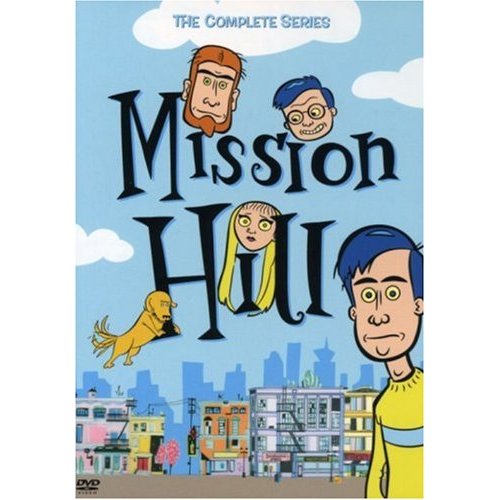
Mission Hill
Image courtesy of Amazon.com.
This week, I’ve been watching Mission Hill: the Complete Series on DVD. In a lot of ways, it’s an unremarkable cartoon from the late ’90s/early ’00s. Most of the characters are pretty standard fare: Andy French, ostensibly our protagonist, is a 20something slacker who would do great things if only he didn’t spend all his time drinking heavily and being more than a bit of a jerk; Andy’s high school brother, Kevin, who comes to live with Andy through a trite, unlikely scenario, and is your stereotypical “nerd” character (seems slightly Asbergers to me, but I might just see that because of my job); and their roommates, Jim and Posey, who are the stoner and the hippie chick, respectively (though Jim is shown to have slightly more layers to him than that; he ends up being an IT/computer specialist for a big ad company and eventually helps Andy get a job in their art and design department). Honestly, none of these characters or character types are all that original, even if they are usually pretty well-done in the show.

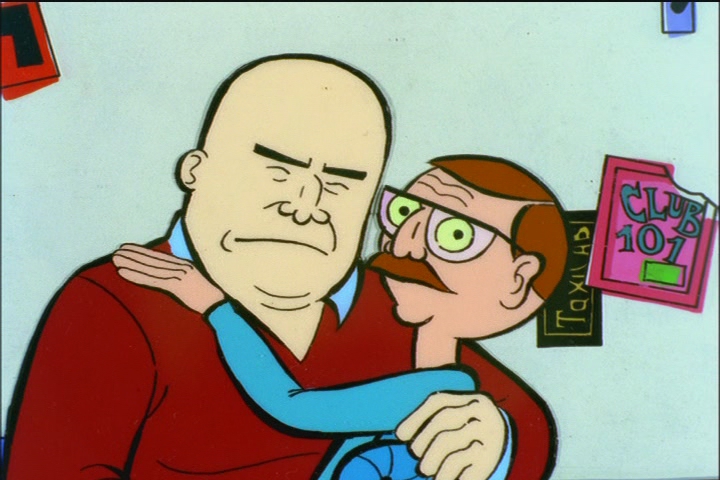
No, where the show really shines is in the portrayal of one of the only two monogamous, committed relationships in the entire series: Wally and Gus (the other, between Carlos and Natalie, is notable for being a healthy, interracial marriage where race never even really seems like an issue between the two). Wally and Gus, two older, gay men, have the healthiest, most realistic relationship in the entire series, and possibly the most realistic portrayal of a gay relationship on all of television.

Wally and Gus
Image courtesy of fanpop.com.
Wally and Gus are presented as well-rounded, human characters. Yes, they are gay, but that is merely a facet of their personalities as opposed to the defining characteristic that guides every action they take. They are clearly in a loving, long-term relationship, one where there are occasionally arguments (what long-term relationship doesn’t have those?) and disagreements, but there’s a commitment and a warmth to their interactions that’s beautiful to watch. It’s not exploitative, it’s not played for laughs (except insomuch as any relationship is treated as a source of amusement and entertainment in a comedy show), and it doesn’t go for the cheap shots or stereotypes.

What’s more, the characters around them treat the couple as perfectly normal. Now, it saddens me in this day and age that I’d even have to point that out, or that it might be uncommon or strange, but that’s the sad reality we live in: it may be the 21st century, but most folks are still more than a little uptight about LGBT relationships. But Andy, Kevin, Jim, Posey, and the rest all treat Wally and Gus as just two other people who live in the building; no more, no less.

That’s what’s so enormously progressive about this particular show, and why I think I appreciate it despite its blatant mediocrity in pretty much every other aspect of its existence: the writers made these two characters feel natural and real.

Their best episode is the series finale, a touching ode not only to the bad cinema of Ed Wood but to the power and draw of True Love. In the episode, Wally is an up-and-coming film director working with some of the biggest stars of the screen, directing a big-budget sci-fi epic that everyone is certain will be a blockbuster success. But then he meets Gus, and everything about the film falls apart: Wally puts Gus in the lead role even though Gus can’t act his way out of a wet paper bag, the rest of the cast quit, and the studio kills the project. Wally takes his film to a small-time studio, reworks the entire script to fit his new leading man (and less-than-stellar supporting cast), and does a no-budget Ed Wood-style b-film that is so bad, he hid it from the world for 50 years. When Kevin discovers the movie and hypes it up with the neighborhood, Wally’s sense of self-worth is devastated, but it’s nothing compared to how horrible he feels for putting Gus in a position of ridicule. The thing is, Gus doesn’t really give a damn what people think of him, as long as Wally’s happy. And ultimately, Wally figures that out, deciding that a movie that brings people joy (it’s a hilariously bad film) can’t be that bad, and he can live with his shame at having produced a real stinker if he’s got Gus. Which he definitely has. The final shot of the episode (and of the series, as it turns out) is of Wally and Gus in bed, content with each other. It’s a heartwarming, emotionally-charged moment for a show that usually did jokes about alcohol and hookers, and it hits all the right notes. Honestly, if you watched no other episode of the series than this one, you’d think it was a pretty damn good show. I think if they’d been able to produce more stuff like this one 22-minute piece, the show wouldn’t have been canceled.