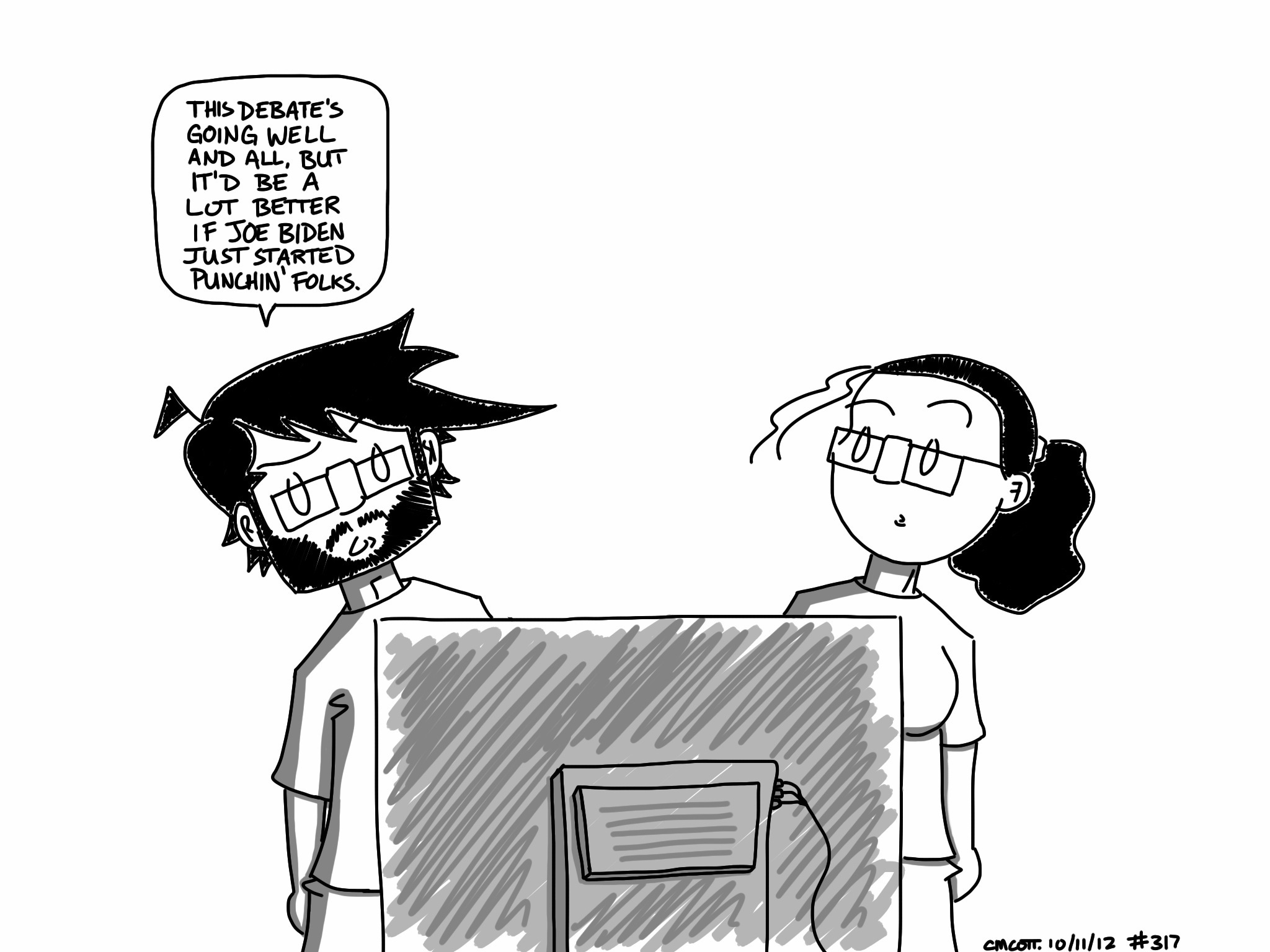
“I don’t think I’m going to vote in the election this year,” my grandfather tells me over the phone last night after the Vice Presidential Debate. “Both campaigns are just way too negative,” he continues, and I find myself having a hard time disagreeing with him. Negative attacks and mudslinging have been a part of politics for about as long as politics has existed; even so, this particular election feels particularly negative and muddy. What really brought it into clarity for me was a question in the debate last night from a soldier: to paraphrase, it was “do you think this campaign is too negative, and do you regret any of the things your side has done in the campaign?” Both VP candidates immediately launched into attacks against the opposition. It was frustrating and, frankly, a bit disgusting that they couldn’t even answer a question about negativity without resorting to attacking their opponent.
And so my grandfather has decided not to support either major-party candidate. He lives in Oklahoma, so it’s not like his vote will actually be missed much: if he voted Republican, well, so does 90% of the rest of the state; and if he voted Democrat, well, see previous statement about how many people in Oklahoma vote Republican.
It brings up an interesting issue: are our votes actually equal? In a state like Oklahoma (a state so red, it’s gotten into the dirt), voting for the Democratic candidate in the presidential race has no impact on the number of electoral votes that candidate will receive, because the state is obviously going to go to the Republican candidate every time. The reverse is true for voting Republican in a state like California or New York. So does the person who votes in one of those Sure Thing States really get to have as much of a say in who becomes president as someone voting in a swing state? I live in Virginia, and the 2008 election was the first one of my life where I felt I actually had a real voice in the process. It was a close race between Obama in McCain in 2008, and it looks to be just as close between Obama and Romney next month. The way I choose to vote could be the difference between Obama getting the state or Romney winning it. So does my grandfather’s vote in Oklahoma have the same weight and impact on the election as my vote here? I would argue it does not.
All of this, of course, boils down to that archaic institution, the Electoral College. Originally designed to prevent the presidential election from just being a popularity contest, it has long since become the appendix of the electoral process: sure, it’s there, but it doesn’t really do much of anything useful, and occasionally it causes the whole system to have life-threatening trouble (see the 2000 race, when Gore won the popular vote but managed to lose the election anyway in the Electoral College). When we vote in the presidential election, we don’t get to vote directly for the candidate. Instead, we vote for electors, one group per party, and they are the ones who actually decide who the president will be. In theory, the electors could go against the popular vote of the state if they thought a different candidate would be a better choice; in practice, the electors are chosen by their respective parties because they are individuals who will select the candidate they’re told to.
So really, it’s hard for me to be mad at my grandfather for abdicating his role in the electoral process. In the grand scheme of things, one candidate isn’t going to have that much of an effect on our country, and one vote isn’t going to be the deciding factor in the state of Oklahoma. With the Electoral College, the concept of “one man, one vote,” supposedly so central a tenet to the American system, really isn’t true. Maybe it’s time to ditch the archaic “winner take all” electoral system and go with a straight popular vote.






 Sketches From Memory