
Holy crap, we’re at 300.
Also, I’m caught back up again from the comic I missed Friday night. Hurray!

Holy crap, we’re at 300.
Also, I’m caught back up again from the comic I missed Friday night. Hurray!
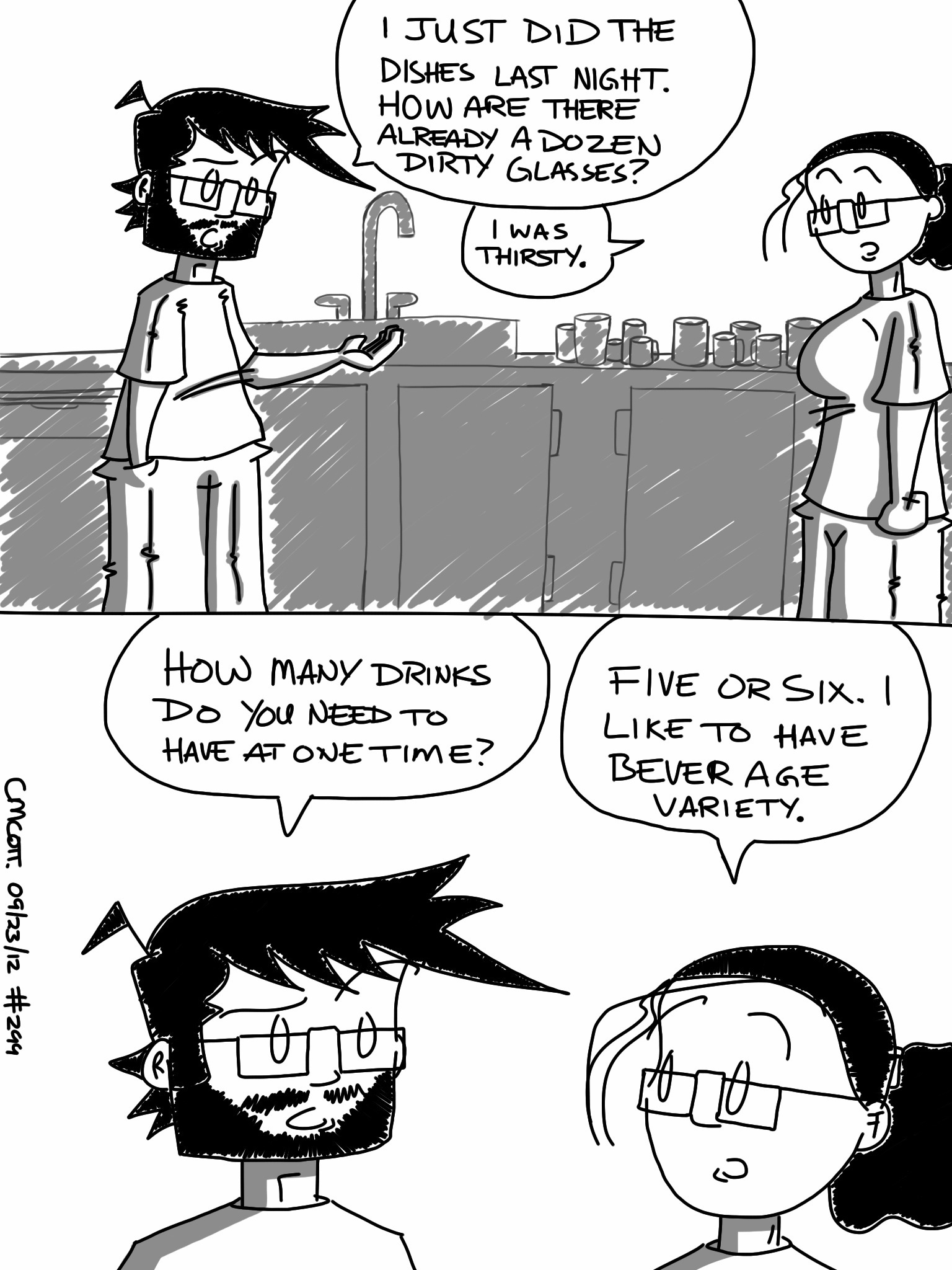
Realized while drawing this comic that I’d misnumbered the last several. I’ve gone back and fixed them in the archive.
Anyway, my wife does this. We usually has no fewer than 3 different drinks around her at any given time.
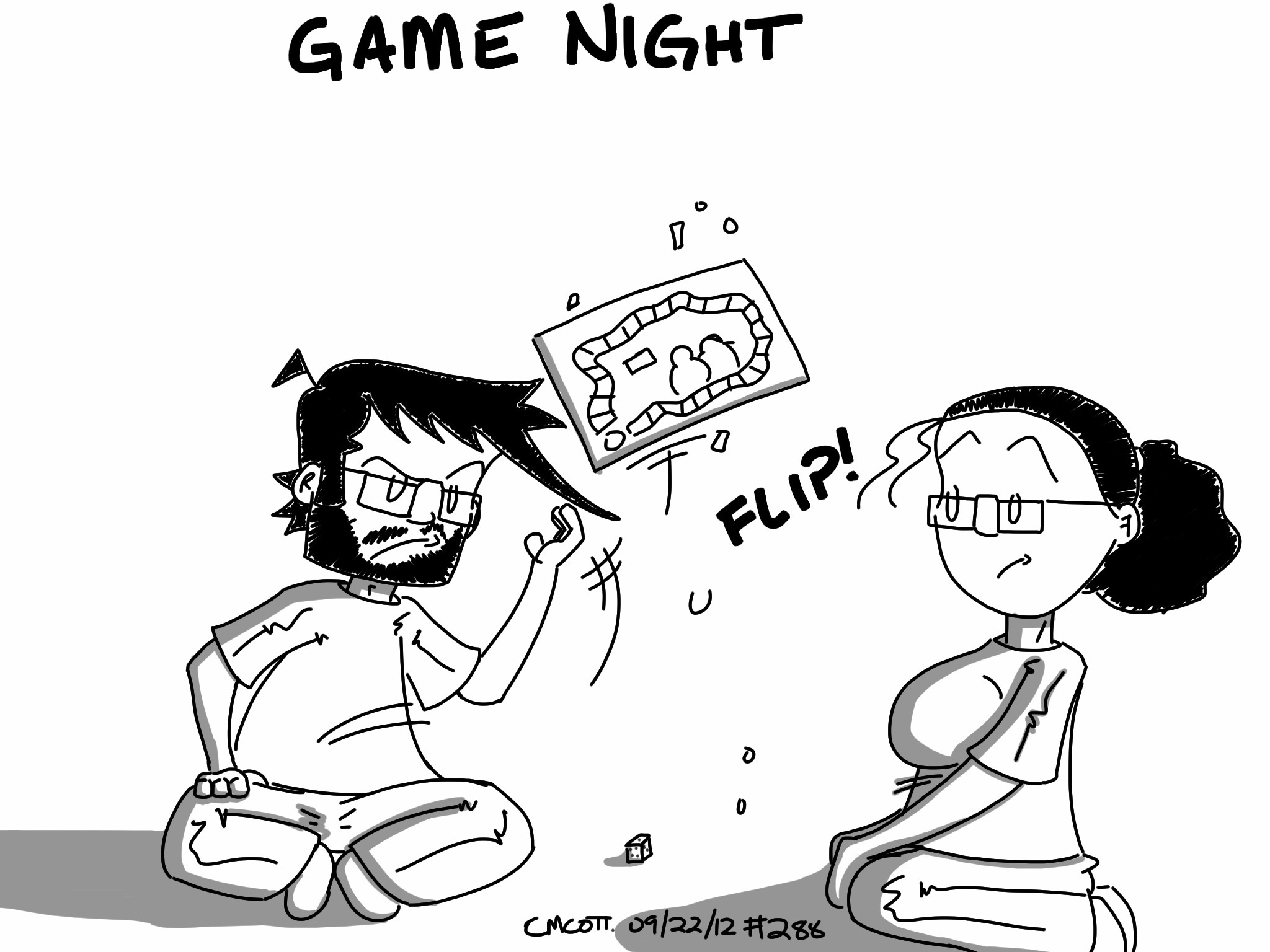
We had board game night tonight. I…did not win.
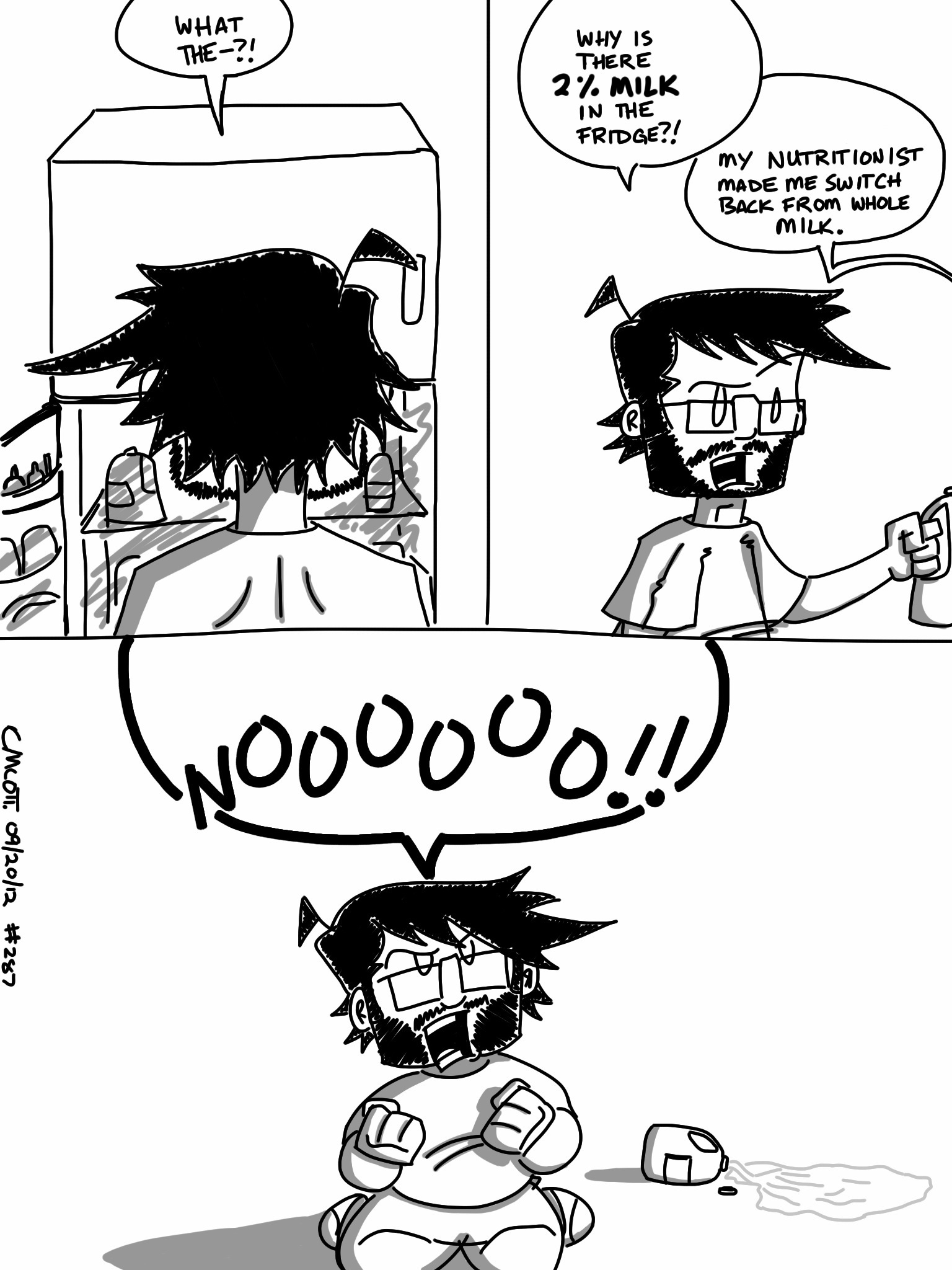
I swear to God, 2% milk is an abomination.
 I am, as even a cursory glance at this blog will readily prove, a pretty damn big Dylan fan. And when I heard he was putting out another album, I was – as is to be expected – pretty damn excited. And honestly, the album is pretty great. It’s got some solid songs on it, Dylan’s voice is in fine (albeit raspy, gravely) form, and I enjoyed it from beginning until almost the end. But…
Well, it doesn’t honestly grab me, y’know? Usually, with a Dylan album, I want to start it over again right after it finishes. That…didn’t happen here. This is an excellent album, but it’s an album I feel like I’ve already heard three times before.
Don’t get me wrong: there’s plenty of great stuff to be mined from the styles Dylan’s been working in since Love and Theft (still my favorite Dylan record of the past thirty years), but it feels like the always-restless Dylan is just spinning his wheels here. Dylan and his band still do their thing with skill and even finesse, but there’s nothing here he hasn’t already done before. There are no surprises, no sudden detours in an unexpected direction (either lyrically or sonically), and honestly, it’s just not what I was hoping for.
The positive side, though, is that if you haven’t heard anything by Dylan in the past ten or twelve years, this album will feel pretty fresh to you. And really, the songs are generally quite good. Things start off well with “Duquesne Whistle,” an old-fashioned train song done in an old fashioned style. The subtle steel guitar work is reminiscent of Hank Williams, Sr., which is never a bad thing. “Early Roman Kings” borrows the riff from “Mannish Boy,” but does it on accordion (which isn’t a surprise at all if you’ve heard Together Through Life, but it fits as though there’s never been any other way to play it). “Pay In Blood” is one of Dylan’s darker comic songs, featuring the recurring line “I’ve paid in blood, but it’s not my own.” Other songs, such as “Soon After Midnight” and “Narrow Way,” work very well, and the first half of the album is pretty fantastic.
The second half, though, is bogged down by the last two tracks: the sprawling, lethargic title track, a story song about the sinking of the Titanic that does nothing new or interesting with the topic, and the album’s closer, “Roll on John,” a tribute to John Lennon that borrows lyrics from several of Lennon’s own songs and feels about thirty years too late. They’re both duds, falling quite flat, and they bring the end of the record down considerably.
Ultimately, Tempest isn’t going to win any new converts to the Cult of Dylan. It’s good, but there’s really nothing to distinguish it from the three albums that came before. While I can’t fault Dylan for pursuing the styles and themes he wants to (it’s led to same damn fine music over the years), I’m starting to have a tough time following him down the path.

New iOS update! I have Siri on this thing now.

This may be the last daily sketch, as I fully expect Meredith to kill me for using the phrase “Meredith juice.” it’s been fun, people.

We do have back to school night tomorrow. My boss did remind all of us to dress well, which led to quite the discussion about what we should wear. This was the outfits ultimately landed on, though I think there was a serious consideration that we all wear parachute pants for a few minutes.
I came to Elliott Smith a little late in the game: after his success had already led to major label records, before his untimely death. Like so many others, my introduction to his work was Either/Or, still one of the single best records ever (admittedly, I would also say the same about XO and probably Figure 8). I was upset when I learned about Smith’s death, because it meant we wouldn’t be getting anymore albums from him.
Then they announced From a Basement on the Hill, and I was both excited and very, very nervous.
See, I think there’s something definitely dangerous about the posthumous album. Releasing an unfinished record after the artist’s death is, at best, a gamble, and at worst a crass cash grab. Hell, Tupac’s released more albums since he died than he did when he was still alive. Unfinished work either ends up sounding like exactly that (unfinished, skeletal demos) or some sort of elegiac, overproduced thing that tries to cover up the fact that there wasn’t more than a verse and a half and most of a chorus put together before the guy died.
So I was worried about Basement, and I’ll admit that for the longest time, I did not care for the record. I ranked it down at the bottom of Smith’s catalog. Compared to any other album in his oeuvre (yeah, that’s right, I’m bustin’ out the French), it just didn’t fit. Bits of it were rough and ramshackle, while other parts felt overproduced, and the whole thing felt completely unlike any other Elliott Smith album. It didn’t feel like it was his. The fact that there was a fair amount of controversy over the production and mastering of the album when it came out only served to confirm my fears.
But today, I decided to give it a second chance. It was, after all, a collection of songs written by Elliott Smith, so there had to be something worthwhile in there. And I was surprised to discover that, in fact, while there are a couple of odd missteps, this is actually an album that fits in with his catalog and manages to almost synthesize all the different stages of his career.
The album opens with the atypical rocker “Coast to Coast,” a song that doesn’t have a comparison in the rest of his solo work. With the heavily distorted drums and grungy guitar, it sounds more like an outtake from his previous band, Heatmiser. However, it quickly bounces to more familiar territory, with the softly-plucked acoustic and multi-tracked vocals of “Let’s Get Lost” and the fuller sound of “Pretty (Ugly Before),” which would have felt of a piece with Figure 8.
What’s particularly interesting about the album is that it feels rather like Smith’s attempt to synthesize the Beatles’ Revolver into his own work. Not that this record sounds anything like Revolver, just that the guitars in several places bear a striking resemblance in tone and style to the guitar work on Revolver. It does feel like Smith is also attempting to push the boundaries of his style the way the Beatles did on Revolver.
I do think that this album is still the weakest of Elliott Smith’s career. The songs just don’t feel as complete or as tightly-plotted as on his other records. The lyrics aren’t as sharp, and feel too much like retreads of topics and themes he’s already addressed in other songs to better effect. It is by no means a bad record, just not as great as his other stuff. I’ve reconciled myself to this being the final Elliott Smith album (even if not the final collection of Elliott Smith recordings, as the wonderful 2006 collection of odds and sods, New Moon, proved). While not the best album of his all-too-short career, it’s still worth a listen.
 Sketches From Memory